
Children usually meet the Bible as a stack of separate stories. Noah builds a boat. David faces a giant. Daniel spends a night with lions. Each one is memorable on its own, and each one arrives without a date, a place, or a clear relationship to the story before it. The result is a child who can retell a dozen accounts but cannot say what order they happened in — or why the whole thing hangs together.
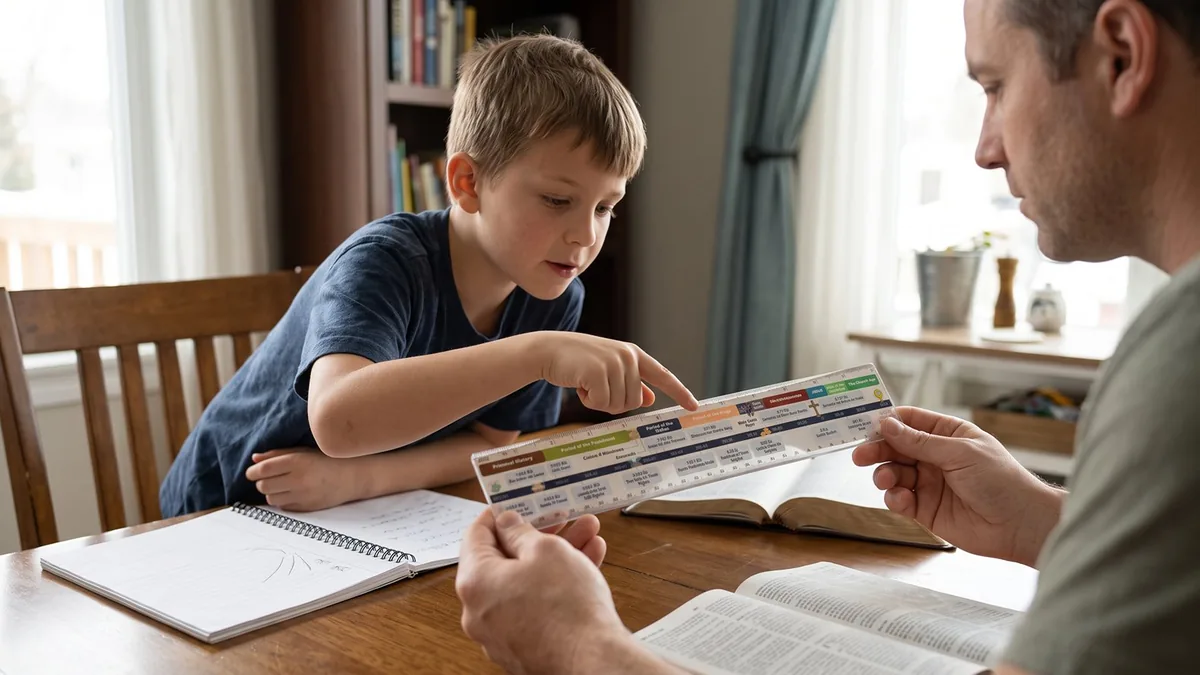
A timeline is the simplest correction. We print a Bible timeline on a clear acrylic ruler precisely because of the scene in the photograph below: a parent and a child at a kitchen table, an open Bible, and one strip that shows where each story sits in the larger story. What changes is not the child’s memory for facts. It is their sense of the shape of the Bible as a single narrative.
Why order matters more than dates
Most children do not need to memorize years. They need a sequence. Knowing that Abraham comes before Moses, that the exile comes after the kings, and that the gospels sit at the far end of the line is enough to turn scattered stories into a route.
Once a child has the route, two things happen. First, new stories have somewhere to land: a Sunday school lesson about Elijah stops being a standalone anecdote and becomes a marker on a line the child already knows. Second, questions get better. Children who can see the whole arc start asking why things changed, not just what happened.
Dates are still printed on the ruler, but they are secondary. They answer “roughly when,” and then they get out of the way.
How we use it with a child
- Start with a story they already know. Ask them to find it on the ruler first, before reading anything new. The familiar story becomes an anchor.
- Move the ruler, not the Bible. Keep the passage open and slide the ruler alongside it. Pointing at one strip is faster than flipping to a chart at the back of a study Bible.
- Let them place the next story. Read a passage, then ask where it belongs. Being wrong is useful — correcting the position is where the learning happens.
- Leave it on the table. A timeline that lives in a drawer gets used twice. One that stays within reach gets picked up during ordinary conversation.
Ten minutes is enough. This is not a curriculum and it does not need to be scheduled. The point is repetition: the same line, seen often, in different contexts, until the outline is simply known.
What to look for in a timeline for children
- Readable at arm’s length. Small print on a wall chart forces children to walk up to it. A ruler-sized format can be read while sitting together.
- Color-coded periods. Color does the work that a legend cannot: a child can tell at a glance that a story belongs to the patriarchs, the kings, or the early church.
- Durable enough for actual use. Paper tears at the fold after a few months. Clear acrylic wipes clean and survives being handled, dropped, and used as a bookmark.
The timeline ruler we make is 12 inches, double-sided, and printed on clear acrylic so the text stays legible over an open page.
From the kitchen table to the classroom
The same object works in a Sunday school room, a homeschool co-op, or a family devotion setting, because the requirement does not change: children need to see the sequence while the passage is still in front of them. Teachers tend to want one per child rather than one per class, which is why we keep a bulk option for churches, schools, and bookshops.
Read next
- A Bible history timeline you can keep on your desk — the same object, read as a sequence of eras rather than a set of dates.
- What is printed on the front face — the nine era bands and the dated events that anchor them.
If you are ordering for a group, see our wholesale terms, or write to us directly at jincc@bible-chart.com with the quantity you have in mind and where it will be used. We are also happy to discuss custom printing for a specific curriculum or event.