
How long is a cubit? Eighteen inches — 45.7 centimetres — which makes Noah’s ark roughly 137 metres long. That single conversion is the one most readers go looking for, and it is printed on the back of our ruler along with the rest of the biblical units: time, lengths, dry and liquid measures, money, and weights.
The front side gives you the timeline. The back side is the reference table — the part you actually reach for mid-chapter, when a number in the text means nothing until it is stated in inches, litres or grams.
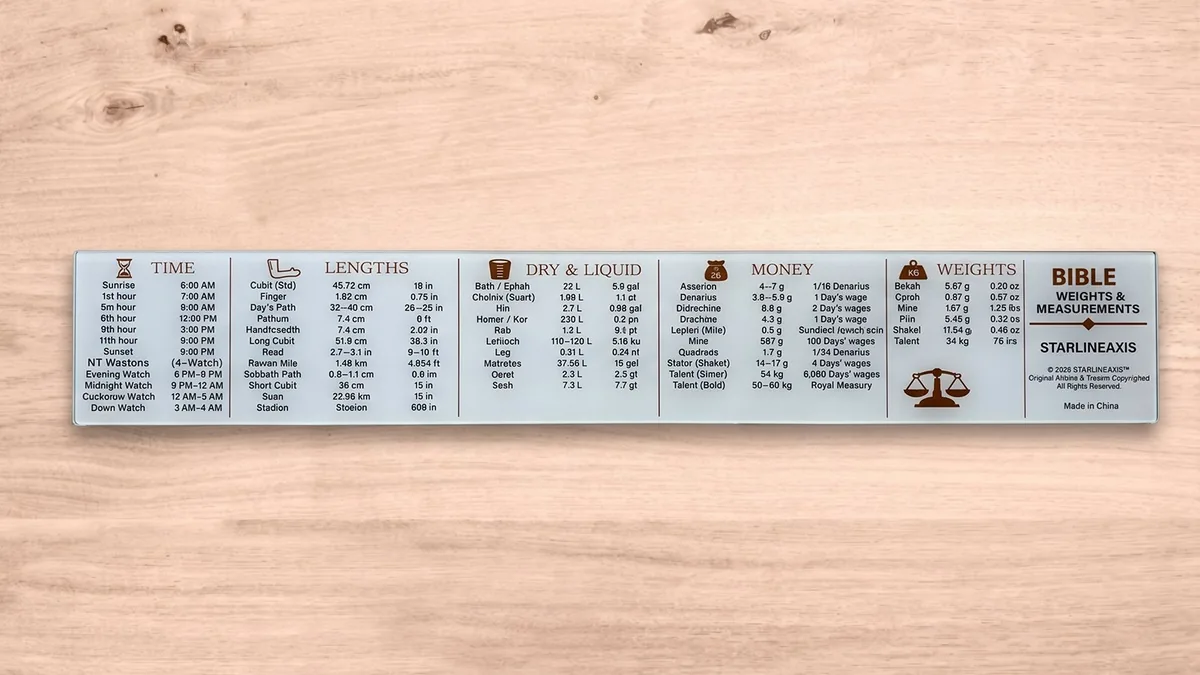
How long is a cubit, and the other lengths
The standard cubit is 45.72 cm, or 18 inches. The short cubit is 45 cm. A span is half a cubit at 22.86 cm, a handbreadth is 7.4 cm, and a long cubit — the one used in Ezekiel’s temple measurements — is 51.9 cm.
Above that come the larger units: a reed at roughly 2.7 to 3.1 metres, a stadion at 185 metres, a Roman mile at 1.48 km, and a sabbath day’s path at roughly a kilometre. Goliath at six cubits and a span reads differently once you can see that he stands close to three metres.
Liquid, dry, money and weights
The capacity blocks work the same way. A bath or ephah is 22 litres — about 5.8 gallons — a chomer is ten times that at 220 litres, a hin is 3.7 litres, a log is 0.31 litres, and a seah is 7.3 litres. When a recipe, an offering or a prophecy specifies an ephah, you can see the actual volume.
Money is given in wages rather than metal weight, which is more useful anyway: a denarius and a drachma are one day’s wage, a didrachme is two days’, a stater four days’, and a lepton — the widow’s mite — is a fraction of a denarius. On the weights side, a shekel is 11.4 g, a mine 567 g, and a talent 34 kg, which is what makes the parable of the talents land.
Kept where you read
This side only helps if it is within arm’s reach while you read. That is the argument in our note on keeping weights and measures on the desk: the reference you actually consult is the one already in front of you.
Read next
- A Bible history timeline you can keep on your desk — the other side of the ruler, and why desk objects beat charts you have to search for.
- Reading the front face — how the chronology side is laid out from Creation to the Church Age.
See the full product line, or the wholesale terms if you stock bookstores or church resource tables. For pricing and custom print runs, email jincc@bible-chart.com or message WhatsApp +82 10-4928-1918.